At its core, motor insurance is a contract between you and an insurance company. You pay a small fee (the premium), and in exchange, the insurer promises to cover your financial losses resulting from accidents, theft, or damage caused to others.
To understand complex policies, you must first understand the two "ingredients" they are made of.
The legal minimum. Protects you if your vehicle causes injury, death, or property damage to someone else.
The voluntary part. Covers repairs for your car due to accidents, fire, natural disasters, and theft.
When you buy a brand-new vehicle in India, you will often see codes like OD1TP5 for two-wheelers or OD1TP3 for cars. These are long-term bundles mandated by the Supreme Court of India to ensure vehicles stay insured for longer.
It gives you the flexibility to switch your "Own Damage" provider every year for a better deal, while keeping the "Third-Party" part stable and compliant for the long haul.
Not sure which cover does what? Here is a simple breakdown of how Third-Party Liability and Own Damage policies differ.
A timeline of growth, innovation, and commitment to excellence
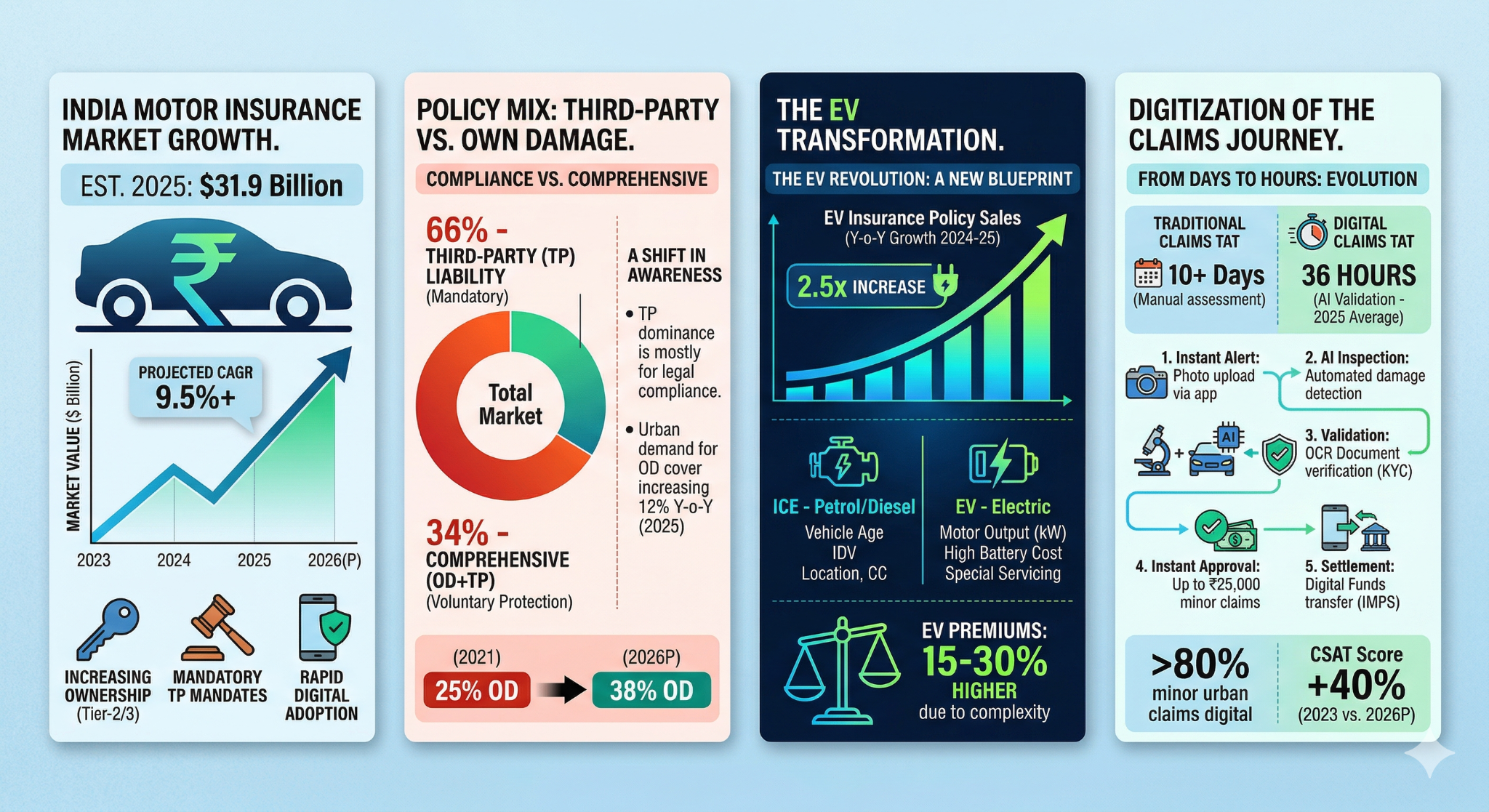
The Indian motor insurance market reached an estimated valuation of $31.9 Billion in 2025 and is projected to grow significantly as vehicle ownership rises in Tier-2 and Tier-3 cities.
Approximately 66% of the market share currently belongs to Third-Party policies, showing that while many people insure for legal compliance, there is a massive shift toward Comprehensive plans (OD + TP) as awareness grows.
With India's "Green Push," EV insurance purchases grew nearly 2.5x year-on-year in 2025. These policies often carry higher premiums due to the high cost of specialized battery systems.
Thanks to AI integration, claim processing times in India have dropped from an average of 10 days to just 36 hours for minor digital claims.
Indian consumers are becoming "protection-first." Over 74% of policyholders now opt for Roadside Assistance, while 60% choose Zero-Depreciation covers to avoid out-of-pocket expenses during claims.